NEWSLETTER: AUGUST 2026
On the Path to Sainthood – How the Catholic Church Recognizes a Saint
By Johnson Louisnaden, Saints & Relics team lead (PDCC Consultative Team)
Saints hold a special place in the life of the Catholic Church. They are honoured not simply because they were good people, but because their lives demonstrated extraordinary faith, courage, charity and devotion to God.
The process by which the Catholic Church officially recognizes a person as a saint is known as canonization. It is a careful and often lengthy process involving historical research, examination of the person’s life and writings, testimonies from witnesses, theological review and, ordinarily, the verification of miracles attributed to the person’s intercession.
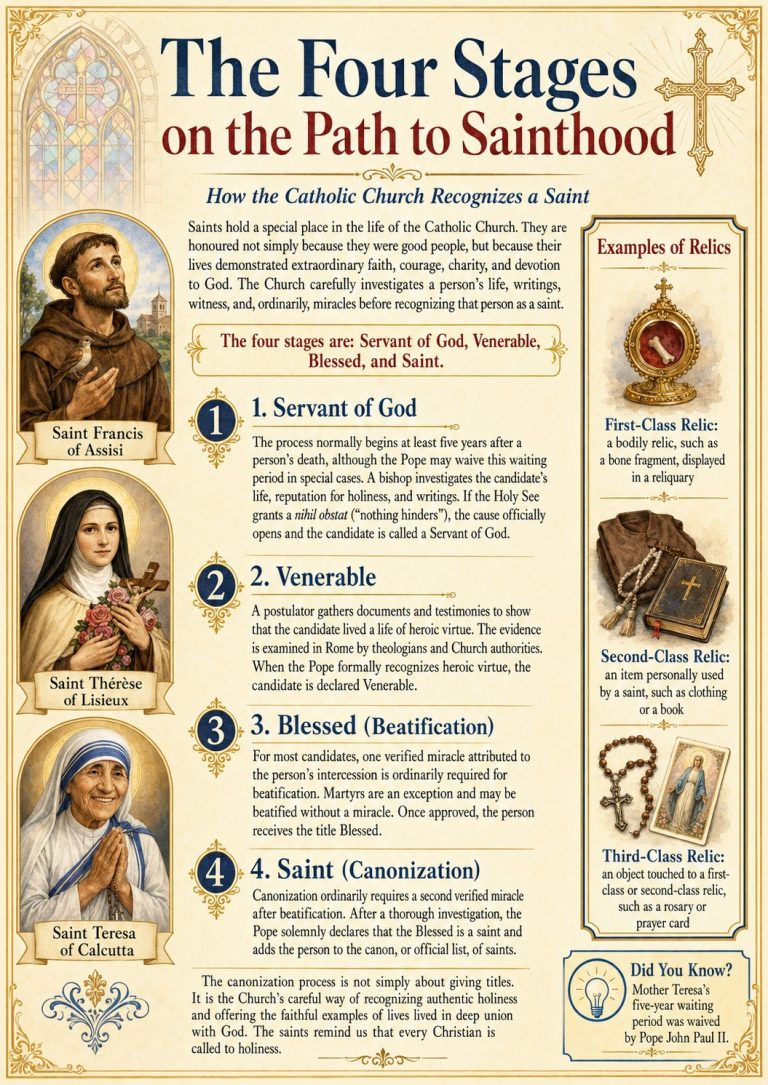
The journey towards canonization is commonly explained through four stages of recognition:
Servant of God, Venerable, Blessed and Saint.
- Servant of God
The process normally begins at least five years after the person’s death. This waiting period allows time for emotions surrounding the person’s death to settle and helps ensure that the investigation can be conducted objectively.
However, the Pope may waive the five-year waiting period in exceptional circumstances. One well-known example was the cause of Mother Teresa.
A request to open the cause is usually made to the bishop of the diocese where the person died. The bishop begins an initial investigation into the candidate’s life, reputation for holiness, writings and actions.
Before proceeding, approval is sought from the Holy See. When there is no objection to opening the cause, a nihil obstat may be granted. This Latin expression means “nothing stands in the way” or “nothing hinders.”
Once the cause has officially begun, the candidate is given the title Servant of God. In the Diocese of Penang, Cardinal Sebastian Francis opened the cause of beatification and canonization for Sybil Kathigasu (1899-1948) on 1 July 2024.
- Venerable
The next stage involves a more detailed examination of the candidate’s life.
A Church official known as a postulator helps coordinate the cause. The postulator gathers documents, historical records and testimonies from people who knew the candidate or are familiar with the candidate’s life and work.
This evidence is presented to the Dicastery for the Causes of Saints in Rome. Historians, theologians, bishops and cardinals examine whether the candidate practised Christian virtues to a heroic degree.
These virtues may include faith, hope, charity, prudence, justice, courage and temperance.
When the Pope formally recognizes that the candidate lived a life of heroic virtue, the person is declared Venerable.
Being declared Venerable does not yet permit the person to be publicly honoured throughout the Church as a saint. However, it confirms that the Church considers the person’s life an exceptional example of Christian discipleship.
- Blessed — Beatification
The third stage is known as beatification.
For a Venerable who was not a martyr, beatification ordinarily requires the recognition of one miracle attributed to the candidate’s intercession. Catholics may ask the candidate to pray for them, just as they might ask a friend or family member to pray for them.
A reported miracle must undergo a strict investigation. In the case of an alleged healing, medical experts examine whether the recovery was complete, lasting and medically inexplicable. Theologians then determine whether the healing can reasonably be connected to prayers made through the candidate’s intercession.
Martyrs are treated differently because they gave their lives for the Christian faith. A miracle is ordinarily not required for a martyr’s beatification.
Once beatification has been approved, the candidate receives the title, Blessed. Public devotion may then be permitted within particular places, dioceses, religious communities or groups associated with the person.
- Saint — Canonization
The final stage is canonization.
Ordinarily, another verified miracle is required after beatification. This miracle undergoes the same careful medical, theological and ecclesiastical examination as the first.
For a martyr who did not require a miracle for beatification, a verified miracle is ordinarily required before canonization. In exceptional circumstances, the Pope may dispense with the usual requirements.
After the necessary investigations have been completed, the Pope solemnly declares that the Blessed is a saint. The person’s name is then added to the Church’s official canon, or list, of saints.
Canonization permits the saint to be publicly honoured throughout the universal Church. The saint’s life is presented as an example for Christians to imitate, and Catholics may confidently ask for the saint’s intercession.
More Than a Title
The canonization process is not simply a system for awarding religious titles. Its purpose is to determine, with great care, whether a person’s life offers an authentic and inspiring example of Christian holiness.
The four titles—Servant of God, Venerable, Blessed and Saint—represent different stages of investigation and recognition. Behind every canonization are years, and sometimes centuries, of prayer, research, testimony and discernment.
Ultimately, the lives of the saints remind the faithful that holiness is not reserved for a select few. Every Christian is called to grow in faith, love God and neighbour, serve those in need and remain faithful through the challenges of life.
References / Further Reading
The following sources provide further information on the Catholic Church’s process of beatification and canonization:
- Dicastery for the Causes of Saints — Sanctorum Mater: Instruction for Conducting Diocesan or Eparchial Inquiries in the Causes of Saints
https://www.vatican.va/roman_curia/congregations/csaints/documents/rc_con_csaints_doc_20070517_sanctorum-mater_en.html - Dicastery for the Causes of Saints — Regulation of the Postulators
https://www.causesanti.va/it/documenti/regulation-of-the-postulators.html - United States Conference of Catholic Bishops — Saints: The Canonization Process and Key Terms
https://www.usccb.org/offices/public-affairs/saints - Vatican News — WWII heroine could be Malaysia’s first saint: Sybil Kathigasu
https://www.vaticannews.va/en/church/news/2024-07/malaysia-begins-canonization-process-wwii-sybil-kathigasu.html
PDCC is the official body that oversees the development of Catechesis in the Diocese of Penang, Malaysia.
Contacts :
- [email protected]
- Rev Deacon Clement
- PDCC Head: 012-435 0566
- Jeanne J Saw
- Communications: 016-455 4597