NEWSLETTER: SEPTEMBER 2026
Accompanying Young People Through Adolescence – The Catechist’s Role in Faith Formation
by Dr June Joseph
I recently attended the Parenting Teens workshop organized by the Penang Diocese Family Life Commission in collaboration with the Diocesan Mental Health Ministry. The programme brought parents and teenagers together in separate sessions to explore adolescent development, family relationships, mental health and the environment in which young people are growing up.
As a public health professional, I found the discussion particularly relevant. Adolescent wellbeing and the current dilemmas surrounding teenagers in Malaysia (e.g. interpersonal and school violence, bullying, abuse, teenage pregnancy, rising child neglect, self-harm and substance abuse) are shaped by many factors: family relationships, friendships, school, digital media and the wider social environment. How adults understand these influences matters greatly to how we respond to young people.
The developmental and mental health perspectives were useful, although I noticed that the sessions had limited explicit Catholic content. This led me to reflect on what could happen when these insights are brought more intentionally into the work of catechesis.
Understanding the Adolescent
Adolescence is a period of significant neurological, psychological and social development. The cognitive capacities involved in judgement, planning, impulse control, emotional regulation and decision-making continue to develop through adolescence and into early adulthood (until their mid-20s or early 30s). At the same time, adolescents may show greater sensitivity to emotional experience, rewards and peer influence. In situations that are emotionally charged and socially significant, these influences can weigh more heavily on decision-making than they do in adulthood.
This does not mean that adolescents lack responsibility or are incapable of making rational decisions. Rather, it highlights the importance of providing guidance, appropriate boundaries and opportunities to practise decision-making. Responsibility develops progressively as young people gain experience and learn to evaluate choices, consequences and competing influences.
This has practical implications for catechesis. Young people need space to think through situations, ask questions, consider consequences and learn to make sound choices in order to develop an informed conscience and the ability to exercise judgement.
The Catechist as Formator
Here, the role of the catechist goes beyond teaching a curriculum. While the roles of father and mother are indispensable, catechists too accompany young people as they develop their understanding of faith, themselves and their relationships with others.
This requires some awareness of adolescent development. A teenager who is withdrawn, distracted or disengaged may be struggling with something outside the catechetical setting. It could involve friendship difficulties, bullying, family circumstances, trauma or emotional distress.
While a catechist does not need to diagnose the problem, what matters is being attentive enough to notice when something may require a different response, a conversation with parents or a referral to someone with the appropriate expertise.
Communication Matters
While healthy faith-oriented boundaries between catechists and young people are necessary so that catechesis does not turn into counselling, adolescents also need to know that they can ask difficult questions and be heard in the setting. This becomes especially important when conversations involve sexuality, relationships, pornography, bullying, abuse or mental health.
Here, a simple approach can be useful:
Listen → Clarify → Validate → Guide.
First, allow the young person to speak. Clarify what has actually happened rather than relying on assumptions. Acknowledge the person’s feelings without necessarily agreeing with the behaviour. Then provide guidance in the light of faith and sound judgement.
Meeting Young People Where They Are
Young people have already encountered ideas about sexuality, relationships, identity, body image, freedom and belonging through friends, family, social media and popular culture.
It is therefore pivotal for catechesis to engage these realities. For example, when teaching about sexuality, young people need to understand why the Church speaks about the dignity of the person, love, responsibility, self-gift and the proper use of freedom –beyond the list of what is allowed and what is not. Conversational opportunities help young people think morally and critically. The same should apply to conversations about pornography, online relationships and peer pressure.
Forming Conscience
Parents, teachers and catechists cannot be present at every moment. The goal of formation is therefore to help adolescents develop the ability to recognize what is right and to choose it freely.
Here, catechists can use real-life situations to encourage reflection in a manner that will help young people to learn to understand and apply a dignified, informed decision-making process. The sequence of reflection could involve: What is happening? Who might be affected? What choices are available? What are the consequences? Is this really a free choice, or is there pressure involved? What would respect for the dignity of the other person require?
Theology of the Body
Theology of the Body has an important place in this conversation.
Adolescents are forming their understanding of their bodies, sexuality and relationships in a culture where people can easily be reduced to appearance, attractiveness or sexual value.
The Catholic understanding begins with the dignity of the person. The body is part of the person and is not an object for use. Here, freedom is connected to truth and responsibility, and love needs to be genuinely self-giving.
Mental Health and Safeguarding
The involvement of the Diocesan Mental Health Ministry is particularly relevant.
PDCC has already taken steps to safeguard our children, including through the ‘Safeguarding Minors’ workshop held online in March 2026. This provides a good foundation.
The next task is to consider how this learning can continue to inform adolescent catechesis, especially as young people increasingly navigate digital spaces. Catechists may encounter concerns involving bullying, grooming, inappropriate online contact, exploitation, abuse or emotional distress. They are not expected to become mental health professionals, but they should be trained to respond appropriately, maintain boundaries, recognize when a concern requires action and follow the Diocese’s safeguarding and referral procedures.
A Practical Protocol for Catechists
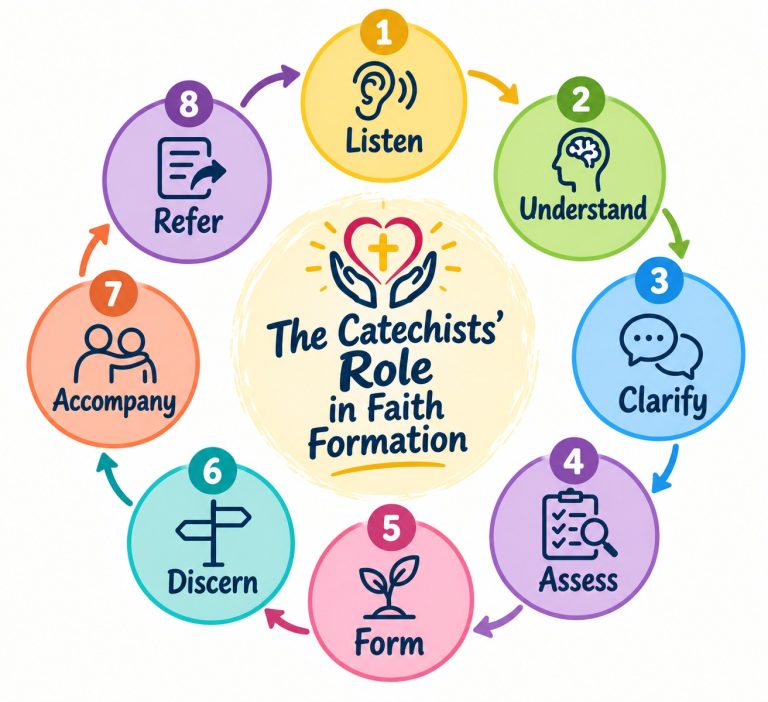
A simple framework could help catechists respond when a young person raises a concern:
- Listen– Give the young person space to speak.
- Understand– Consider the family, peer, school and digital context.
- Clarify– Establish what is known without making assumptions.
- Assess– Identify any safeguarding or serious wellbeing concerns.
- Form– Bring the issue into conversation with Scripture, Catholic teaching and the lives of the saints.
- Discern– Consider dignity, freedom, responsibility and consequences.
- Accompany– Continue appropriate pastoral support.
- Refer– Follow diocesan procedures when the matter requires safeguarding or professional intervention.
A Wider Opportunity for Catechetical Formation
The ‘Parenting Teens’ workshop made me reflect on the fundamental vocation of the catechist and how it complements that of parents in accompanying young people through adolescence. Parents remain the primary educators of their children, while catechists have a particular role in nurturing their faith, forming conscience and helping them connect Christian teaching with the realities of everyday life.
These roles are distinct, but they are deeply complementary. The challenge for catechesis is to meet young people in the realities of their lives and then lead them towards Christ. This means understanding the developmental stage of the young people entrusted to catechists for faith formation, while remaining firmly grounded in the Church’s mission of evangelization and catechesis. The task is to accompany and form young people and gradually entrust them with greater responsibility as they develop towards adulthood.

Dr June Joseph
Dr June Joseph is a Catholic public health researcher, educator and anthropologist whose work bridges faith, public health and human dignity. Her international collaborations focus on maternal and child health, the first 1,000 days of life, women's dignity, breastfeeding advocacy, health equity and the redemptive meaning of suffering through a Catholic lens. She is an Honorary Senior Fellow at the University of Queensland, Australia, and is committed to supporting faith-informed formation, research, policy and community initiatives. She can be contacted at [email protected]
PDCC is the official body that oversees the development of Catechesis in the Diocese of Penang, Malaysia.
Contacts :
- [email protected]
- Rev Deacon Clement
- PDCC Head: 012-435 0566
- Jeanne J Saw
- Communications: 016-455 4597