Category: Uncategorized

  • On the Path to Sainthood – How the Catholic Church Recognizes a Saint

    On the Path to Sainthood – How the Catholic Church Recognizes a Saint

    NEWSLETTER: AUGUST 2026

    On the Path to Sainthood – How the Catholic Church Recognizes a Saint

    By Johnson Louisnaden, Saints & Relics team lead (PDCC Consultative Team)

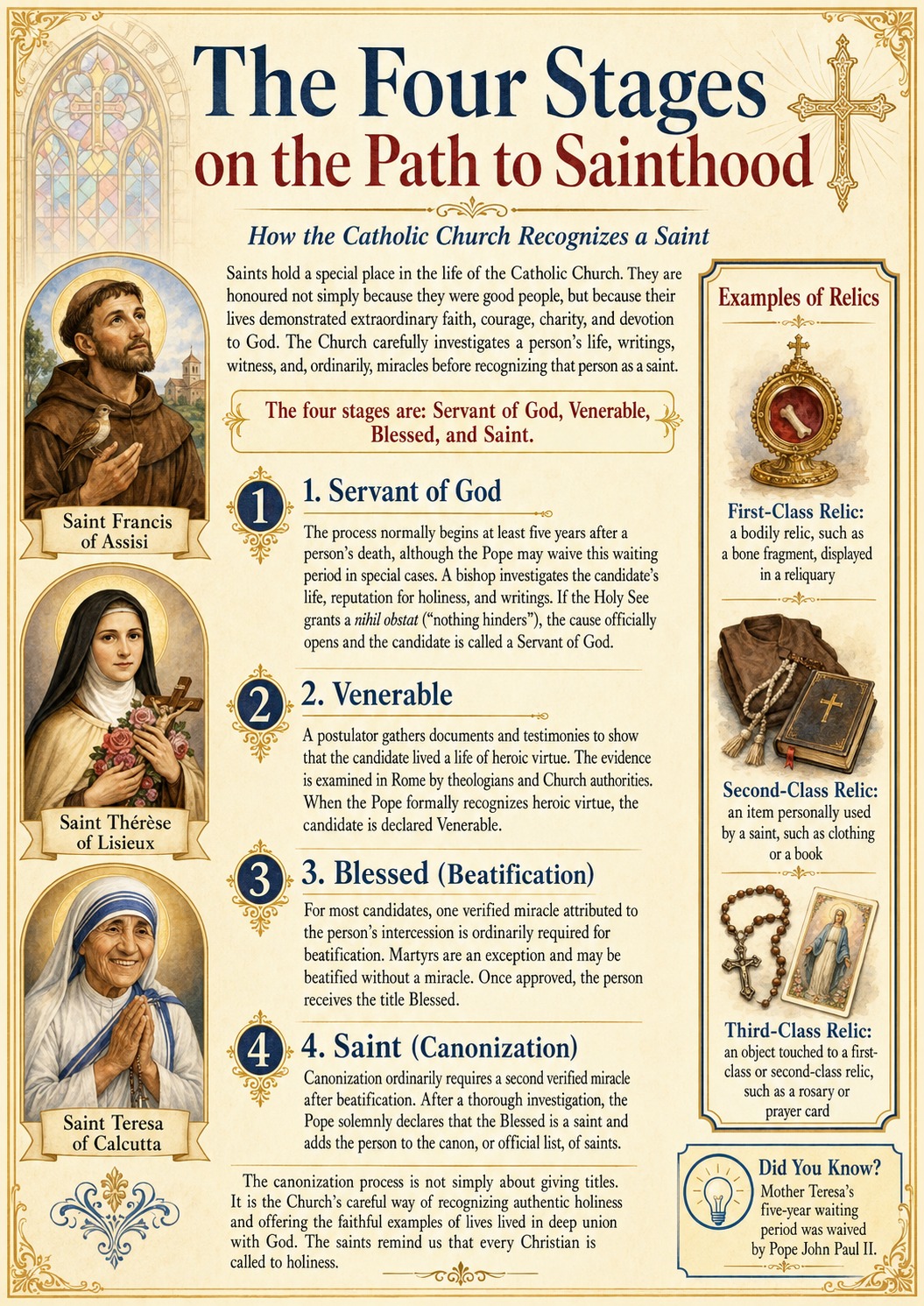
    Saints hold a special place in the life of the Catholic Church. They are honoured not simply because they were good people, but because their lives demonstrated extraordinary faith, courage, charity and devotion to God.

    The process by which the Catholic Church officially recognizes a person as a saint is known as canonization. It is a careful and often lengthy process involving historical research, examination of the person’s life and writings, testimonies from witnesses, theological review and, ordinarily, the verification of miracles attributed to the person’s intercession.

    The journey towards canonization is commonly explained through four stages of recognition:

    Servant of God, Venerable, Blessed and Saint.

    1. Servant of God

    The process normally begins at least five years after the person’s death. This waiting period allows time for emotions surrounding the person’s death to settle and helps ensure that the investigation can be conducted objectively.

    However, the Pope may waive the five-year waiting period in exceptional circumstances. One well-known example was the cause of Mother Teresa.

    A request to open the cause is usually made to the bishop of the diocese where the person died. The bishop begins an initial investigation into the candidate’s life, reputation for holiness, writings and actions.

    Before proceeding, approval is sought from the Holy See. When there is no objection to opening the cause, a nihil obstat may be granted. This Latin expression means “nothing stands in the way” or “nothing hinders.”

    Once the cause has officially begun, the candidate is given the title Servant of God. In the Diocese of Penang, Cardinal Sebastian Francis opened the cause of beatification and canonization for Sybil Kathigasu (1899-1948) on 1 July 2024.

    1. Venerable

    The next stage involves a more detailed examination of the candidate’s life.

    A Church official known as a postulator helps coordinate the cause. The postulator gathers documents, historical records and testimonies from people who knew the candidate or are familiar with the candidate’s life and work.

    This evidence is presented to the Dicastery for the Causes of Saints in Rome. Historians, theologians, bishops and cardinals examine whether the candidate practised Christian virtues to a heroic degree.

    These virtues may include faith, hope, charity, prudence, justice, courage and temperance.

    When the Pope formally recognizes that the candidate lived a life of heroic virtue, the person is declared Venerable.

    Being declared Venerable does not yet permit the person to be publicly honoured throughout the Church as a saint. However, it confirms that the Church considers the person’s life an exceptional example of Christian discipleship.

    1. Blessed — Beatification

    The third stage is known as beatification.

    For a Venerable who was not a martyr, beatification ordinarily requires the recognition of one miracle attributed to the candidate’s intercession. Catholics may ask the candidate to pray for them, just as they might ask a friend or family member to pray for them.

    A reported miracle must undergo a strict investigation. In the case of an alleged healing, medical experts examine whether the recovery was complete, lasting and medically inexplicable. Theologians then determine whether the healing can reasonably be connected to prayers made through the candidate’s intercession.

    Martyrs are treated differently because they gave their lives for the Christian faith. A miracle is ordinarily not required for a martyr’s beatification.

    Once beatification has been approved, the candidate receives the title, Blessed. Public devotion may then be permitted within particular places, dioceses, religious communities or groups associated with the person.

    1. Saint — Canonization

    The final stage is canonization.

    Ordinarily, another verified miracle is required after beatification. This miracle undergoes the same careful medical, theological and ecclesiastical examination as the first.

    For a martyr who did not require a miracle for beatification, a verified miracle is ordinarily required before canonization. In exceptional circumstances, the Pope may dispense with the usual requirements.

    After the necessary investigations have been completed, the Pope solemnly declares that the Blessed is a saint. The person’s name is then added to the Church’s official canon, or list, of saints.

    Canonization permits the saint to be publicly honoured throughout the universal Church. The saint’s life is presented as an example for Christians to imitate, and Catholics may confidently ask for the saint’s intercession.

    More Than a Title

    The canonization process is not simply a system for awarding religious titles. Its purpose is to determine, with great care, whether a person’s life offers an authentic and inspiring example of Christian holiness.

    The four titles—Servant of God, Venerable, Blessed and Saint—represent different stages of investigation and recognition. Behind every canonization are years, and sometimes centuries, of prayer, research, testimony and discernment.

    Ultimately, the lives of the saints remind the faithful that holiness is not reserved for a select few. Every Christian is called to grow in faith, love God and neighbour, serve those in need and remain faithful through the challenges of life.

    References / Further Reading

    The following sources provide further information on the Catholic Church’s process of beatification and canonization:

    1. Dicastery for the Causes of Saints — Sanctorum Mater: Instruction for Conducting Diocesan or Eparchial Inquiries in the Causes of Saints
      https://www.vatican.va/roman_curia/congregations/csaints/documents/rc_con_csaints_doc_20070517_sanctorum-mater_en.html
    2. Dicastery for the Causes of Saints — Regulation of the Postulators
      https://www.causesanti.va/it/documenti/regulation-of-the-postulators.html
    3. United States Conference of Catholic Bishops — Saints: The Canonization Process and Key Terms
      https://www.usccb.org/offices/public-affairs/saints
    4. Vatican News — WWII heroine could be Malaysia’s first saint: Sybil Kathigasu
      https://www.vaticannews.va/en/church/news/2024-07/malaysia-begins-canonization-process-wwii-sybil-kathigasu.html


    PDCC is the official body that oversees the development of Catechesis in the Diocese of Penang, Malaysia.

    Contacts :

  • Time for Reflection for all ECs

    Time for Reflection for all ECs

    NEWSLETTER: AUGUST 2026

    Time for Reflection for all ECs

    PDCC is the official body that oversees the development of Catechesis in the Diocese of Penang, Malaysia.

    Contacts :

  • The Architecture of Faith: Why Youth Are the Present Structure

    The Architecture of Faith: Why Youth Are the Present Structure

    NEWSLETTER: AUGUST 2026

    The Architecture of Faith: Why Youth Are the Present Structure

    By Marie Ann Dawson

    Twenty-five years ago, sitting in the pews of the Cathedral of St. John the Evangelist in Kuala Lumpur, I listened to a homily that stayed with me long after the final blessing. Looking out at the young people gathered in the mother church of the Archdiocese, myself among them, the priest said words that felt both heavy and inspiring: “You are the pillars of the Church.”

    At the time, as a young person navigating my faith, I understood his words quite simply. To me, being a pillar meant an encouragement to roll up my sleeves and serve. It meant joining the parish youth ministry, helping out at food fairs, or singing in the choir. It was about keeping the machinery of parish activities moving, filled with the loud, joyful energy that defines youth groups.

    Looking back now, a quarter of a century later, I appreciate the much deeper theological weight behind that phrase. While Christ alone is the true foundation, the cornerstone upon which everything rests, every baptized person is called to help uphold, sustain, and strengthen His Mystical Body. We are not passive spectators in a spiritual building; as St. Peter reminds us, we are called to be “living stones” built into a spiritual house (1 Peter 2:5).

    For generations, the prevailing narrative in many parishes has been that young people are the “Church of tomorrow.” We invest in them, organize youth camps, and build catechism programs with an eye toward the future, waiting for the day they are ready to lead. But having walked this path for the last twenty-five years, a journey that eventually brought me from the cathedral in Kuala Lumpur to a new spiritual home here in the Penang diocese, I see the subtle danger in that mindset. It implies that until tomorrow arrives, the young are merely waiting in the wings, consumers of ministry rather than active agents of it.

    Pope Francis directly challenged this notion in his post-synodal apostolic exhortation, Christus Vivit (Christ is Alive). Addressing the youth of the world, the Holy Father wrote clearly: “You are the now of God.” They are not the future of the Church; they are its present.

    The young people filling our pews today are an essential part of the Church right now. They bring an energy and an authenticity that a healthy community desperately needs to thrive. More importantly, they are on the front lines of evangelization through concrete community service and the works of mercy. Whether it is feeding the hungry, visiting the lonely, or standing up for the vulnerable in modern urban spaces, young people live out the Gospel in places the institutional Church cannot easily reach. When a young person performs a corporal or spiritual work of mercy with integrity among their peers, they become a vital witness to a world searching for truth.

    However, being a living stone is a two-way street that requires courage from our current youth and trust from parish leadership. To the young Catholics of today, recognizing yourselves as pillars means realizing that your baptism is an immediate commissioning to serve. Do not wait for permission to be the hands and feet of Christ’s mercy to the world.

    To my peers, those of us who were the youth twenty-five years ago and are now the parents, catechists, and parish council members, our call is to open the doors we once knocked on. It means moving beyond assigning youth to superficial tasks and instead trusting them with real shared responsibility in leading these missions of mercy.

    The Cathedral of St. John stands as a beautiful testament to the faith of my past, just as the vibrant parishes of Penang form the landscape of my present. But the true strength of our local Church does not lie in its concrete or stained glass. It lies in the people who fill those spaces across generations. By encouraging our youth to be living stones today, we ensure that the building remains structurally sound for the next twenty-five years and beyond.

    Author Bio:

    Marie Ann Dawson was actively involved in Catholic youth ministry at the Cathedral of  St. John the Evangelist, Kuala Lumpur, twenty-five years ago. She now resides in the Diocese of Penang, continuing to journey with the local church community, with a particular focus on special needs catechism

    PDCC is the official body that oversees the development of Catechesis in the Diocese of Penang, Malaysia.

    Contacts :

  • Celebrating Catechetical Sunday in August 2026

    Celebrating Catechetical Sunday in August 2026

    NEWSLETTER: AUGUST 2026

    Celebrating Catechetical Sunday in August 2026

    In conjunction with Catechetical Sunday, celebrated on Sunday 2 August 2026, Rev Deacon Clement Samuel had a special message (below) for all Evangelizing Catechists (ECs).

    Dear Brothers and Sisters in Christ,

    On this Catechetical Sunday, I would like to express my deepest gratitude and heartfelt appreciation to each one of you for your faithful and generous ministry as Evangelizing Catechists in the Diocese of Penang.

    Our theme this year, “Be Christ to Others,” beautifully captures the vocation to which each of you has been called. Through your words, your witness, your patience, and your love, you make Christ present to the children, youth, and adults entrusted to your care. You are not merely teaching lessons—you are introducing people to a living relationship with Jesus Christ.

    Thank you for the countless hours you dedicate in preparing lessons, accompanying your students, praying for them, and serving our parishes with such generosity. Your ministry often involves unseen sacrifices of time, energy, and personal commitments, yet you continue to answer God’s call with joyful hearts. Please know that your service is deeply valued and sincerely appreciated.

    As the Church reminds us, catechesis is a ministry of hope. Every seed of faith you plant, every child you encourage, every adult you accompany, and every Gospel truth you proclaim can bear fruit for eternity. Although you may not always see the results of your labour, God is at work through your faithful witness.

    May you never lose sight of the privilege and joy of your vocation. Continue to let Christ shine through your lives so that those you teach may encounter Him not only in your words but also in your compassion, humility, and joyful service.

    On behalf of our Bishop, our priests, and the Diocesan Catechetical Commission, thank you for your commitment to building God’s Kingdom. We pray that the Holy Spirit will renew your zeal, strengthen you in every challenge, and fill your hearts with the joy of the Gospel.

    May our Blessed Mother Mary, Seat of Wisdom, intercede for you always, and may the Lord richly bless you and your families.

    Happy Catechetical Sunday!

    “Let your light shine before others, so that they may see your good works and give glory to your Father in heaven.” (Matthew 5:16)

    With gratitude and every blessing,

    Rev Deacon Clement Samuel, Head of Catechetical Commission, Diocese of Penang

    Here are some ways in which Catechetical Sunday was celebrated in some parishes in the Penang Diocese.

    1. On Sunday morning, 2 August, the parish of the Holy Name of Jesus in Balik Pulau celebrated the Catechetical Mass, an annual event organized by the Chinese Catechism Group. Catechism students served in various liturgical ministries, including serving as altar servers, commentators, lectors, choir singers, and taking up the offertory collection.

    This was more than just a Mass; it was an opportunity for the children to grow in their faith. Through their active participation, they gained a deeper understanding of the Eucharistic celebration. By serving in this Catechetical Mass, they also learned responsibility and experienced God’s love.

    The Mass was carried out smoothly, thanks be to God and to our dedicated catechism teachers, who generously gave their time and energy to guide the students throughout the rehearsals. May these young seeds of faith continue to grow into fruit-bearing trees under God’s grace.

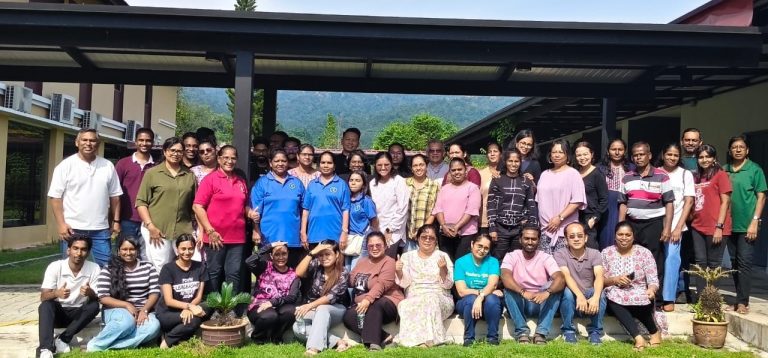
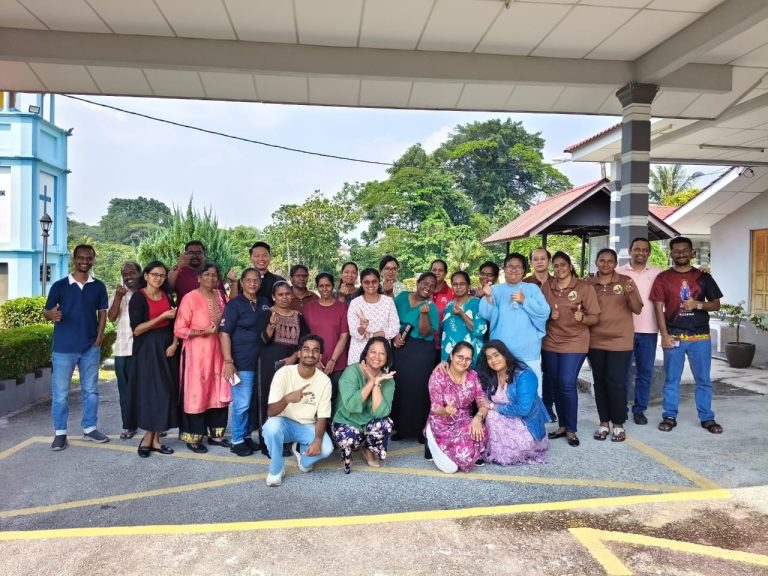
    On 2 August, all ECs spent the afternoon going through EC Module 1 in a face-to-face training session, following six online briefing 6 sessions earlier.

    2. Over in Kota Bharu, there was the Commissioning of Catechists at the Church of Our Lady of Fatima of the Holy Rosary on Friday 31 July 2026, the weekly rest day in Kelantan, Malaysia.

    3. The Catechism Ministry of the Church of the Risen Christ in Penang animated a multilingual Mass on Catechetical Sunday, the Church’s annual celebration of the ministry of catechesis.

    The celebration highlighted the important role of catechists, parents, and the parish community in accompanying children on their journey of faith. Throughout the Mass, catechism children actively participated in various liturgical ministries, including hospitality, proclaiming the readings, commentating, singing in the choir, and presenting the offertory gifts. Their involvement highlighted that catechesis extends beyond the classroom, inviting children to grow as active members of the Church through worship and service.

    A meaningful feature of this year’s celebration was the presentation of the offertory gifts. Many of the gifts were presented by siblings, symbolising the family as the first place where faith is lived and shared. Groceries, generously contributed by catechism children and their parents, will be donated to a welfare home, allowing the offertory to continue beyond the altar as a concrete act of charity and Christian outreach.

    During the Mass, the parish priest of the Church of the Risen Christ, Friar Crispus Mosinoh, OFM, commissioned the ECs serving the children and adults of the parish, affirming their ministry of accompanying children and adults in their faith formation. The children and their parents were also invited to renew their commitment to their own faith journey, recognising that catechesis flourishes when families, catechists, and the parish walk together.

    Following the Mass, the Catechism Ministry hosted breakfast for the children and their families. It was a joyful time for everyone to meet, catch up, and celebrate Catechetical Sunday together.

    The celebration of Catechetical Sunday is a meaningful reminder that faith formation is a shared mission. Through the partnership of parents, catechists, and the parish community, our children are encouraged to grow in faith and become active members of the Church.

    4. Over at the Church of the Sacred Heart in Kampar, Catechetical Sunday was celebrated during the 8.45 am mass on Sunday. Students were the lectors on that day and also took up the offertory gifts which they had prepared and brought.

    In line with the theme for this year, many activities were held earlier on 19 July 2026 during catechism class.  Catechists shared the bible story of the Good Samaritan, focusing on the importance of showing kindness, compassion and helping others regardless of who they are. The students also participated in a simple discussion and activity where they reflected on practical ways in which they can show love and kindness to people in their daily lives, following Jesus’ example.

    Parish priest Father Simon Anand thanked all catechists and RCIA facilitators for their dedication and sacrifices. He mentioned that he understood the challenges faced in instilling the Christian faith in each student, but he knew that the Holy Spirit was always there to help the ECs.

    After Mass, the students were all treated to a ‘pot luck’ breakfast prepared by the ECs of the parish.

    5. At the English Mass on Catechetical Sunday at the parish of Our Mother of Perpetual Help, Ipoh, all Catechism teachers, RCIA facilitators and presenters, the Infant Baptism team and the Catechists of the Good Shepherd Ministry were called up to the altar in appreciation for their service and dedication for promoting the faith in the parish. They were commissioned in front of the whole congregation that morning.

    Thank you to all ECs who shared with us your celebrations for Catechetical Sunday in your parishes this year. Finally, here’s a message from Pope Leo XIV for all ECs!

    PDCC is the official body that oversees the development of Catechesis in the Diocese of Penang, Malaysia.

    Contacts :

  • Finding a Doorway into a Child’s World: An EC’s Reflection

    Finding a Doorway into a Child’s World: An EC’s Reflection

    NEWSLETTER: AUGUST 2026

    Finding a Doorway into a Child’s World: An EC’s Reflection

    By BS, an EC from the Northern Deanery, Penang Diocese


    At Mass that Friday morning, I found myself struggling with a particularly difficult first reading from Nahum, with its vivid images of cracking whips, charging horses, flashing swords and the many slain in the destruction of Nineveh.  As I tried to make sense of what I was hearing, I became conscious of the children of different ages and their evangelizing catechists (ECs) around me.  Some seemed attentive, while others were fidgeting or looking elsewhere.  I could not know what they were making of the reading, but finding it difficult myself, I began to wonder how much of it they might understand.

    The children ranged from about seven to seventeen, so what they could understand and take from the reading would naturally differ.  Language added another layer of difficulty.  The lector proclaimed the reading in Malay, with the text also projected on slides.  The Malay used in Scripture and worship contains words and expressions that are not always part of everyday speech, and even some of us who are bilingual or multilingual can find it difficult to follow.  Beyond the language itself was the unfamiliar world of Assyria and Nineveh.

    All this made me more aware of the distance that can sometimes exist between what is proclaimed or taught and what a child is able to make of it.  Age, language, experience and an unfamiliar biblical world can all contribute to that distance.  What began with that morning’s reading soon opened into a broader reflection on catechesis: how do we, as ECs, help children find a way into what we are trying to share with them?

    The reading from Nahum gave me something concrete to think about.  To make sense of the passage, we first have to enter its world.  Nineveh was the capital of the Assyrian Empire, whose power and brutality had long threatened the people of Judah.  Against that background, the disturbing imagery begins to make more sense.  Nahum offers a suffering people the assurance that God has not abandoned them and that oppression will not have the last word.

    Understanding this passage from Nahum in its own setting is part of how the Church asks us to approach Scripture.  We are to pay attention to the historical circumstances and forms of expression used by the biblical writers (Dei Verbum 12; CCC 110).  But understanding the passage ourselves is only part of the task.  There is still the question of how a child might begin to make sense of it.

    A young child may know nothing about the Assyrian Empire but may understand what it means to be afraid of someone bigger and more powerful.  Beginning with that familiar experience could provide a doorway into the unfamiliar world of the reading and the experience of a people living under the shadow of an empire.

    A doorway into the reading matters, but so does what the child takes away from it.  Without some understanding of the passage, its vivid images of destruction could easily overshadow what Nahum is saying to a suffering people.  The Church reminds us to read Scripture within the unity of the whole of Scripture (CCC 112) and, as Christians, in the light of Christ.  Perhaps then we can help a child discover in Nahum that God sees suffering and does not ignore injustice, and that oppression will not have the last word.

    How we share the faith with children is something we need to keep reflecting on as ECs.  The 2026 Catechetical Sunday theme, “Be Christ to others” (Mt 25:40), is a timely reminder of the children entrusted to our care and of what this ministry asks of us.

    The term Evangelizing Catechist itself says something about the nature of that ministry.  The Directory for Catechesis (2020) places catechesis within the evangelizing mission of the Church, where teaching is joined to witness and accompaniment.  Our Diocese is moving in this direction too as it works towards a renewed catechism syllabus for a new generation.

    In thinking about the children entrusted to this ministry, some words from Cardinal Sebastian Francis come to mind.  Speaking about safeguarding children, he said:

    “Keep the Child at the centre of the narrative of the Kingdom of God as Our Lord Jesus did, and you will never go wrong.”

    His words speak naturally to ECs as well.  Keeping the child at the centre means taking seriously the child before us: age, experience, language, questions and capacity to understand.  It does not move Christ from the centre of what we proclaim; rather, it asks us to consider how that proclamation might reach the child we are actually teaching.

    Knowing what we teach matters; so does knowing whom we teach.  Doing both can make catechesis demanding.  Knowledge matters, but so do imagination, discernment, patience and a willingness to listen.  Children come to us with different ages, experiences, languages and capacities for attention and understanding.  What engages one child may not reach another.

    Language can add another layer to that challenge.  Some children may be more comfortable in Malay or in a language they use at home or school, while ECs themselves may have to find ways of expressing the faith clearly in a language or register that is not always easy for them either.  Even when EC and child share the same language, the words and expressions of Scripture and worship may not belong to everyday speech.  Finding language that can reach the child can therefore be part of finding the doorway, without losing what lies beyond it.

    The limited time we have with children adds to the challenge.  Listening to the homily that morning, I was reminded that even the priest has only a few minutes to break open the Word and leave something with the congregation.  ECs too have only so much time with the children each week.  We cannot say everything in the time we have, so perhaps the question is what we most hope the children will carry with them.

    Beyond completing a lesson, there is the deeper hope of accompanying them in faith and gradually leading them towards Christ.  What remains may sometimes be quite small: an insight remembered, a question still being pondered, a glimpse of God that continues to grow after the hour is over.

    That leaves me wondering what we are planting in the time we have with them. It may be something whose growth we never see.

    Faced with so many demands, ECs need courage and a willingness to keep growing in their ministry.  Good intentions alone are not enough; formation and practical skills matter too.

    Our preparation matters too.  Catechesis calls for more than preparing a lesson.  It calls for recollection, prayer and reflection: time to sit with what we hope to share, to understand it as best we can and to allow it first to speak to our own lives.  We are, after all, sharing a faith that we ourselves are still learning to live.

    Jesus himself so often begins with what people know: seeds and bread, sheep and lamps, families and meals.  From the familiar, he opens a way towards something deeper.

    And so, I find myself returning to the two images that have emerged from this reflection: the doorway and the seed.  We look for a doorway through which a child might enter, and we try to plant something that may remain and grow.  We may not always find the right doorway, nor see what becomes of the seed.

    Perhaps that is part of the humility of being an EC.  We prepare, pray and sow as faithfully as we can, while recognising that the growth is not ours to command.  We are trying to lead children towards Christ while learning, ourselves, to follow him.  Perhaps the call to “Be Christ to others” begins there.


    PDCC is the official body that oversees the development of Catechesis in the Diocese of Penang, Malaysia.

    Contacts :

  • Towards a Renewed Catechism Syllabus: A Journey of Faith for the New Generation of Young People

    Towards a Renewed Catechism Syllabus: A Journey of Faith for the New Generation of Young People

    NEWSLETTER: JULY 2026

    Towards a Renewed Catechism Syllabus: A Journey of Faith for the New Generation of Young People

    By Rev Deacon Clement Samuel, Head of PDCC

    With the formal approval of Cardinal Sebastian Francis, Bishop of Penang, granted on 30 March 2026, the Penang Diocesan Catechetical Commission (PDCC) is embarking on a transformative journey to renew our diocesan catechism syllabus. This initiative, presented to all clergy during their monthly recollection in July 2026, represents a vital “pastoral conversion” to ensure the faith remains a living, breathing reality for our young people.

    A Shared Vision with the Clergy

    During the clergy presentations, we reflected on two biblical images from Pope Leo XIV’s encyclical Magnifica Humanitas: the Tower of Babel and Nehemiah. While Babel represents a technocratic paradigm that reduces persons to data, Nehemiah represents the priestly role—hearing the cry of a devastated city and working with the people to rebuild the walls of the faith brick by brick. Our clergy were reminded that they are the “first catechists” in their parishes, called not merely to be administrators but to be “catechists of catechists” who accompany their flock.

    Why a New Syllabus?

    The current syllabus, serving since 2006, was designed for a pre-smartphone era. Today, we face a “cultural transformation” where digital technology is not just a tool but a “spiritual habitat” (DC 19, 362). Our youth are caught in a “Digital Vortex” that shapes their identity through algorithmic mediation rather than an encounter with the Creator.

    The new framework moves away from the “textbook coverage fallacy”—the mistaken belief that finishing a book equals formation—to a Catechumenal Model. As the Directory for Catechesis (2020) states, “The baptismal catechumenate is the model that inspires all catechesis” (DC 62).

    The Master Framework

    The renewed syllabus adopts a cyclical (spiral) approach, revisiting the core mysteries of faith & life (60 topics) with increasing depth across four developmental cycles. Each Cycle will follow the systematic five-fold process:

    • Why be a Catholic?
    • How to become a Catholic?
    • How to live as a Catholic?
    • How to deepen your life as a Catholic?
    • How to become a Missionary Catholic?

    There are normally about 30 Catechism Classes a year. 20 classes will cover the 20 topics, and 10 classes in a year will be used for revision with various activities: Para liturgy, Encounter Jesus session, Games(relationship building exercises), pilgrimage and/or outreach projects.

    Implications for the Parish

    This renewal calls for the parish to become an “apprenticeship of the entire Christian life” (DC 75) with the Kerygma as centre and part of on-going formation (DC 57). It implies a shift towards doing catechesis “WITH” families rather than just “FOR” them, recognizing parents as the primary catechists. Parishes need to

    • offer on-going formation for the Evangelizing Catechists (DC 139-149),
    • involve the youths to evangelize the youths (DC 250) and
    • organize creative and participatory liturgies (DC 95) where the young will experience the mysteries that are celebrated with their daily lives.

    Timeline for Action

    • August – December 2026: Drafting of lessons and pilot runs in selected parishes.
    • January – June 2027: Nihil Obstat phase for theological and doctrinal scrutiny.
    • July – December 2027: Translation into BM, Tamil, and Mandarin.
    • June 2026 – December 2027- Formation of all Catechists (Basic Course & How to use the New Syllabus)
    • 2028 – 2030: Three-year trial run in all diocesan parishes.
    • 2028- Formation of Parents of Young people.

    At the conclusion of the Clergy presentation, the Bishop of Penang affirmed the direction taken by PDCC and thanked all who are working hard to accomplish this work. He also asked PDCC to keep the Malaysian Catechetical Commission (MCC) updated. In conclusion, he reminded the Clergy that the Universal Church had already for some time been speaking about how to respond to the changes taking place through the digital and AI revolution as evidence by the teachings of Pope St John Paul II, the latest Directory For Catechesis (2020) and the latest Encyclical by Pope Leo on AI. He shared that we are called to be “Bridge builders” but through the biblical image used by Pope Leo of Nehemiah, we are also called to “Build Walls” to protect God’s people especially the young who are most vulnerable and impressionable. Finally, he also gave a word of caution that in spite of all we do, there will be casualties and we as a Church have to, in the words of Pope Francis “Be a Field Hospital’ to bring healing and deliverance to those who have fallen.

    Let us then as Evangelizing Catechists, move forward as “wise architects” to ensure that our children do not just “learn religion,” but truly meet Jesus Christ.

    PDCC is the official body that oversees the development of Catechesis in the Diocese of Penang, Malaysia.

    Contacts :

  • Celebrating the Parish Feast in Kulim, Kedah

    Celebrating the Parish Feast in Kulim, Kedah

    NEWSLETTER: JULY 2026

    Celebrating the Parish Feast in Kulim, Kedah

    by Mariaselvam (PDCC Core Team – Catechism)

     The parish community of the Sacred Heart Church, Kulim came together in deep faith and joyful fellowship to celebrate the Feast of the Sacred Heart of Jesus in June 2026. The evening began with a solemn outdoor Blessed Sacrament procession through the streets of Kulim. Hundreds of parishioners followed reverently with candles in hand, singing hymns and offering prayers for peace and renewal. Beneath a flower-adorned canopy, the radiant monstrance symbolized Christ’s love shining upon the town—a moving reminder that His Heart burns with mercy and compassion for all.

    After the procession, the faithful gathered in the church for the Feast Day Mass, celebrated with heartfelt devotion. The liturgy reflected the theme of the Sacred Heart—God’s boundless love and mercy. In the homily, the congregation was encouraged to live out this love in their daily lives: reaching out to those in need, nurturing unity within families, and strengthening the bonds within the parish. The celebration concluded with a fellowship dinner in the parish hall, where laughter and warm conversation filled the air. Volunteers served delicious local dishes, and parishioners of all ages shared stories and gratitude for the blessings of the day. The event beautifully reflected the spirit of the Sacred Heart—love expressed through prayer, service, and togetherness.

    Voices from the Congregation about the celebration

    “The Sacred Heart of Jesus is the very name of our parish. His Heart is aflame with love, mercy, and kindness. It was heartening to see our catechism children and youth deeply involved in the celebration, assisting with traffic during the procession, serving as altar servers, and carrying flowers during the outdoor procession. It was wonderful to see their heartfelt joy and spiritual reverence.” – Sister Jane, Catechist

    Other parishioners shared:

    “Walking with the Blessed Sacrament through town reminded me that Jesus walks with us in every part of our lives.” – Parishioner 1

    “The fellowship dinner afterward felt like being part of one big family—faith truly brings us together.” – Parishioner 2

    PDCC is the official body that oversees the development of Catechesis in the Diocese of Penang, Malaysia.

    Contacts :

  • Helping Young Catholics Discover the Beauty of the Human Person through Theology of the Body

    Helping Young Catholics Discover the Beauty of the Human Person through Theology of the Body

    NEWSLETTER: JULY 2026

    Helping Young Catholics Discover the Beauty of the Human Person through Theology of the Body

    by Dr June Joseph, PhD

    Catechists are among the Church’s most important formators that accompany children and young people as they encounter Christ through Sacred Scripture, the sacraments and prayer. At the heart of this ministry is helping them discover what it means to live as beloved sons and daughters of God.

    Children and young people today are growing-up in a postmodern culture shaped by competing understandings of identity, purpose and belonging. Conversations about friendship, body image, family and romantic relationships, success and self-worth often emerge directly or indirectly in catechism classes and interpersonal student-teacher-friend interactions. Beneath these conversations lies a deeper question that every person asks, ‘Who am I?’.

    The Catechism of the Catholic Church’s response to this question is life-giving. Every person is created in the image and likeness of God, redeemed by Christ and called to communion with Him. This truth provides the foundation upon which the Christian life is built.

    In an era that is frequently confused about identity and meaning, St. John Paul II’s Theology of the Body offers catechists a pivotal resource. While the Theology of the Body is often viewed through the lens of marriage and human sexuality, its theological foundations extend well beyond these themes. Rooted in Christ’s invitation to return ‘to the beginning’, it recovers God’s original plan – that every person is created in His image, is called to communion, and made for self-giving love.

    While introducing the Theology of the Body is important, its deeper contribution lies in offering a theological lens through which the whole of catechesis can be understood. Through this lens, Creation reveals each child’s God-given dignity, the sacraments draw them into Christ’s life, and Christian morality is lived as a response to God’s love. Rather than presenting the faith as a series of disconnected doctrines, catechesis invites children to see the coherence of God’s loving plan for humanity.

    The story of Creation, for example, can invite children to reflect on why humanity alone is created in the image and likeness of God. This simple shift encourages them to see themselves, the unborn, and those who are lonely, different or struggling with the dignity that God has already bestowed on every person.

    Creative pedagogy can deepen theological understanding by helping children encounter, rather than simply learn about, the faith. Sacred art, storytelling, guided reflection, body mapping, saint role plays and acts of service invite them to discover that they are created in God’s image, called to communion and made for love. In this way, catechesis forms mind, heart and soul.

    My work in public health has shown me that people flourish when they know they are loved, valued and belong. The Theology of the Body deepens this insight by reminding us that every person is created ‘by Love, for love and to become a sincere gift to others’. Helping children discover this truth may be one of catechesis’ greatest contributions to their lifelong formation.

    The invitation here is to introduce the Theology of the Body not only as a catechetical topic, but also as a theological lens through which the faith is taught. Over time, its vision of the human person can bring greater unity to Scripture, the sacraments, Christian morality and vocation, enabling catechesis to form young disciples who know Christ, understand their God-given dignity and live in the Joy of the Gospel.

    Dr June Joseph is a Catholic public health researcher, educator and anthropologist whose work bridges faith, public health and human dignity. Her international collaborations focus on maternal and child health, the first 1,000 days of life, women’s dignity, breastfeeding advocacy, health equity, and the redemptive meaning of suffering through a Catholic lens. She is an Honorary Senior Fellow at the University of Queensland, Australia, and is committed to supporting faith-informed formation, research, policy and community initiatives. She can be contacted at [email protected].

    PDCC is the official body that oversees the development of Catechesis in the Diocese of Penang, Malaysia.

    Contacts :

  • What Does It Mean to Be Human in the Age of AI?

    What Does It Mean to Be Human in the Age of AI?

    NEWSLETTER: JULY 2026

    What Does It Mean to Be Human in the Age of AI?

    by Jeffry Christopher, Evangelizing Catechist at the Church of St Mary, Tapah

    Reflecting on Pope Leo XIV’s first encyclical, Magnifica Humanitas (Magnificent Humanity), May 2026

    Artificial intelligence (AI) is now part of our everyday lives. It answers our questions, finishes our sentences, suggests what to watch, and even writes essays. Many of us, whether teachers, parents or children, use it without thinking twice. So, what does our faith have to say about it?

    In May 2026, Pope Leo XIV gave us his first encyclical, Magnifica Humanitas. The Pope’s message is both hopeful and clear. AI is not evil, and the Church is not against new technology. However, he reminds us, technology is never neutral as it carries the values of the people who design and use it. So, we must guide it wisely, always asking one question: does this help people truly flourish?

    Three simple ideas from the Pope

    • We are made in God’s image. Our worth is a gift. The Pope teaches that the dignity of each person is neither acquired nor earned, nor does it need to be justified. It does not depend on what we produce or how useful we are.
    • AI can imitate us, but it cannot love. It has no conscience, no empathy, no soul. Love, work and responsibility remain uniquely human.
    • We must remain human. The Pope calls us to remain profoundly human and to treasure a grandeur in the person that no machine can ever replace.
    For Evangelizing Catechists

    AI can be a helpful classroom assistant, but only if it stays a tool and never the teacher of the faith. A few practical ways to begin:

    • Use AI to save time, not to replace prayer or witness. Let it help you draft quizzes, brainstorm activity ideas or simplify Scripture passages and then review it carefully, because AI can be confidently wrong.
    • Always verify against trusted sources. Compare anything AI produces with the Catechism of the Catholic Church (CCC), the YOUCAT and Church teachings before using it with children.
    • Teach discernment, not just facts. Ask your class: “Can a machine pray? Can it forgive? Can it love you?” These questions open beautiful conversations about the soul.
    • Protect real encounter. The Pope warns against technology that isolates us. Fill your sessions with discussion, eye contact, shared prayer and human warmth – the things no app can provide.
    For Parents

    You are your child’s first teacher of the faith, and that has not changed. AI makes your role more important, not less.

    • Be curious together. Sit with your children when they use AI. Ask what it told them, and gently talk about whether it is true, kind and helpful.
    • Guard family time. Phones and clever apps are designed to capture attention. Protect meals, night prayers and Sunday Mass as screen-free moments of real togetherness.
    • Model healthy technology use. Children copy what they see. Let them notice you putting the phone down to listen, to pray, and to be fully present.
    • Talk about human dignity. Remind your children that a person is precious because God made them. Not because of likes, followers or how productive they are.
    For Children

    Here are simple things to remember and try.

    • You are wonderfully made. God loves you just for being you. Not for being fast, clever or useful. A computer can never be loved the way God loves you.
    • A robot can talk, but it cannot care. AI does not have a heart or a soul. Only people can truly love, forgive and pray.
    • Use, then unplug. Enjoy helpful technology, then switch off and play, help at home, and spend time with family and friends.
    • Always ask a trusted adult. If something online confuses or worries you, tell a parent, teacher or catechist. Real people are there to help you.
    Our hope

    Pope Leo XIV does not ask us to fear the future, but to face it as Catholics with wisdom, courage and love. AI may help us heal the sick, educate the young and connect people across the world. But the Pope reminds us, technology is never neutral, and there is a grandeur in the human person that no machine can ever replace. The real question is not how powerful our machines become, but whether we will remember what it truly means to be human. Even in the age of AI, may we bear witness to the grandeur of humanity, in which God has made His dwelling.

    Credits: AI

    PDCC is the official body that oversees the development of Catechesis in the Diocese of Penang, Malaysia.

    Contacts :

  • Leading to the Knowledge of Faith

    Leading to the Knowledge of Faith

    NEWSLETTER: JULY 2026

    Leading to the Knowledge of Faith

    by Rt. Rev. Bishop Joseph Hii Teck Kwong

    15071
    By Rt. Rev. Bishop Joseph Hii Teck Kwong, Bishop of Sibu and Episcopal Advisor to the Malaysian Catechetical Commission

    The ministry of Catechesis is much more than the transmission of religious knowledge. It is not merely about teaching doctrines, preparing candidates for the sacraments, or helping people memorize prayers and teachings of the Church. While these are important, the ultimate purpose of Catechesis is to lead God’s people to the faith. Every human person is created by God and for God. Deep within every heart is a longing for something greater than ourselves. St. Augustine beautifully expressed this truth when he said:

    “You have made us for Yourself, O Lord, and our hearts are restless until they rest in You.”

    These words continue to speak to every generation. They remind us that the human heart seeks meaning, purpose, peace, and happiness. Ultimately, this longing can only be fulfilled by God Himself. Our role as catechists is to help people recognize this longing and discover that God alone can satisfy the deepest desires of the human heart. The purpose of Catechesis, therefore, is to awaken faith and lead people to encounter the One for whom they were created. What is this faith that we seek to nurture? Our faith is centred on the Person of Jesus Christ. Christianity is not primarily a philosophy, a moral system, or a set of religious practices. Christianity is a relationship with Jesus Christ, the Son of God. The Gospel of John 1:14 tells us:

    “The Word became flesh and dwelt among us.”

    Jesus Christ is the Living Word of God. In Him, God enters human history. Through His Incarnation, God reveals His face to humanity. Therefore, the goal of every catechetical programme, every lesson, every formation session, and every sacramental preparation is to lead people to encounter Jesus Christ personally. When people encounter Christ, they discover that through Him they have access to the Father. This is beautifully expressed in the great doxology proclaimed at every Eucharist:

    “Through Him, and with Him, and in Him, O God, Almighty Father, in the unity of the Holy Spirit, all glory and honour is Yours, forever and ever.”

    Catechesis must help the faithful appreciate this profound mystery—that through Jesus Christ we are brought into communion with God the Father in the unity of the Holy Spirit. The late Pope Francis has often reminded us that Catechesis is not about memorizing religious facts. Rather, its purpose is to facilitate a living encounter with Jesus Christ. Such an encounter transforms lives and empowers us to become who God created us to be.

    In this journey of faith formation, I would like to highlight three important dimensions.

    1. Catechesis helps us discover ourselves. Unless we know ourselves as beloved children of God, it becomes difficult to hear God’s voice and discern His will. Faith formation helps us recognize our dignity, our vocation, and our identity as sons and daughters of God.
    2. Catechesis helps us discover others. Faith is never a private possession. It draws us into relationships. It teaches us to move beyond self-centredness and to encounter our brothers and sisters with love, compassion, and understanding. We grow in faith through communion with others.
    3. Catechesis leads us to discover God. The ultimate purpose of all faith formation is to foster an intimate and personal relationship with the living God. The more we come to know ourselves and others, the more we become capable of knowing and loving God.

    Knowing oneself, knowing others, and knowing God form the foundation of true communion. This communion finds its origin in the mystery of the Holy Trinity. The Father loves the Son. The Son loves the Father. The Holy Spirit is the bond of love between the Father and the Son. We are created in the image of this Trinitarian God. Therefore, every catechetical effort must ultimately lead people into communion—with God and with one another.

    My dear brothers and sisters, there is another important lesson that we must never forget. While we catechize others, we ourselves are continually being catechized. As catechists, we are not merely teachers. We remain disciples. Jesus teaches us in Matthew 25:40:

    “Whatever you did for one of the least of these brothers and sisters of mine, you did for me.”

    When we serve the poor, the sick, the hungry, the imprisoned, and the stranger, we encounter Christ Himself. In these encounters, Christ becomes our teacher. Through the lives of those we serve, He forms our hearts in humility, compassion, patience, and mercy. In serving others, we ourselves are evangelized and catechized by the Lord. This reminds us that Catechesis is not only a ministry of teaching but also a ministry of listening, learning, and on-going conversion.

    As I conclude, I wish to remind all of us that faith is ultimately a gift from God. The seed of faith planted within us must be nourished and allowed to grow. Prayer remains the essential means through which this growth takes place. Prayer enables us to enter into a personal relationship with the living God. Through prayer, we come to know Jesus more deeply. Through prayer, we encounter Him in the ordinary and concrete realities of daily life.

    The task entrusted to us as catechists is therefore both beautiful and sacred: to lead God’s people to the knowledge of the faith by leading them to Jesus Christ. May our Catechetical ministry help every person discover who they are, grow in communion with others, and ultimately enter into a living relationship with the Triune God. May we never cease to be catechists who are ourselves continually being catechized by Christ.

    Thank you for your dedication, your generosity and your witness to the Gospel.

    May God bless all of you and your ministry abundantly.


    PDCC is the official body that oversees the development of Catechesis in the Diocese of Penang, Malaysia.

    Contacts :