NEWSLETTER: JULY 2026
Towards a Renewed Catechism Syllabus: A Journey of Faith for the New Generation of Young People
By Rev Deacon Clement Samuel, Head of PDCC
With the formal approval of Cardinal Sebastian Francis, Bishop of Penang, granted on 30 March 2026, the Penang Diocesan Catechetical Commission (PDCC) is embarking on a transformative journey to renew our diocesan catechism syllabus. This initiative, presented to all clergy during their monthly recollection in July 2026, represents a vital “pastoral conversion” to ensure the faith remains a living, breathing reality for our young people.
A Shared Vision with the Clergy
During the clergy presentations, we reflected on two biblical images from Pope Leo XIV’s encyclical Magnifica Humanitas: the Tower of Babel and Nehemiah. While Babel represents a technocratic paradigm that reduces persons to data, Nehemiah represents the priestly role—hearing the cry of a devastated city and working with the people to rebuild the walls of the faith brick by brick. Our clergy were reminded that they are the “first catechists” in their parishes, called not merely to be administrators but to be “catechists of catechists” who accompany their flock.
Why a New Syllabus?
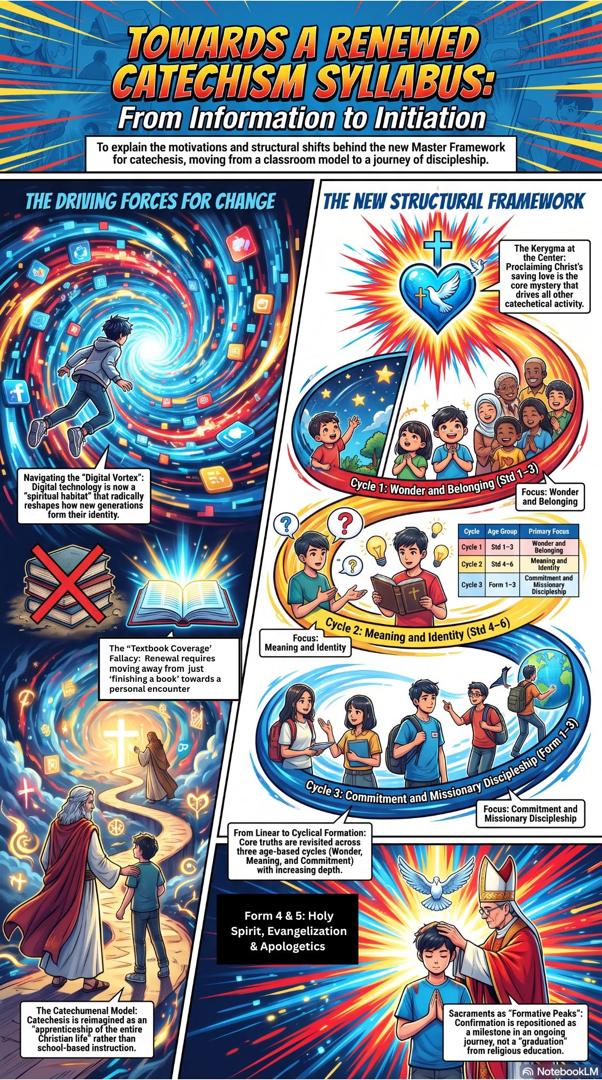
The current syllabus, serving since 2006, was designed for a pre-smartphone era. Today, we face a “cultural transformation” where digital technology is not just a tool but a “spiritual habitat” (DC 19, 362). Our youth are caught in a “Digital Vortex” that shapes their identity through algorithmic mediation rather than an encounter with the Creator.
The new framework moves away from the “textbook coverage fallacy”—the mistaken belief that finishing a book equals formation—to a Catechumenal Model. As the Directory for Catechesis (2020) states, “The baptismal catechumenate is the model that inspires all catechesis” (DC 62).
The Master Framework
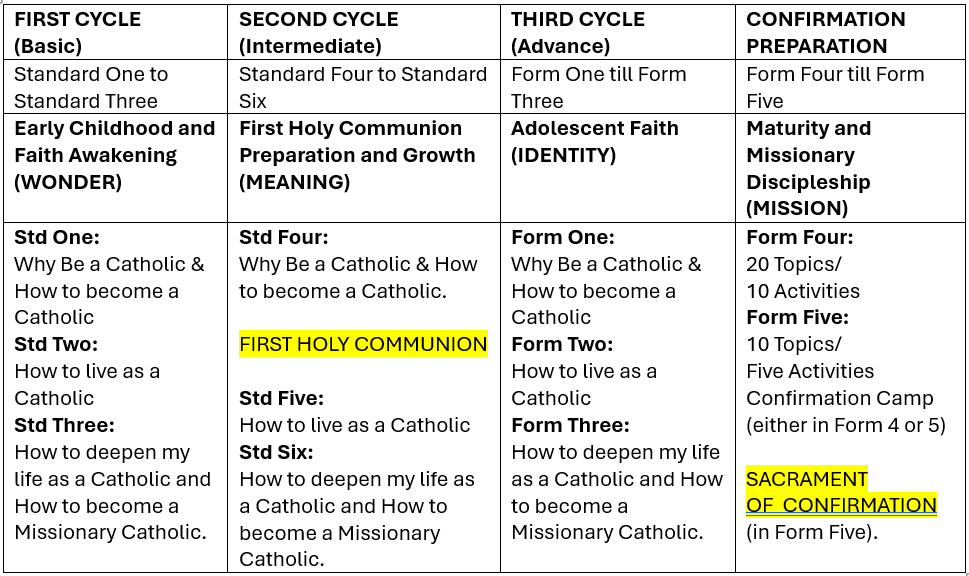
The renewed syllabus adopts a cyclical (spiral) approach, revisiting the core mysteries of faith & life (60 topics) with increasing depth across four developmental cycles. Each Cycle will follow the systematic five-fold process:
- Why be a Catholic?
- How to become a Catholic?
- How to live as a Catholic?
- How to deepen your life as a Catholic?
- How to become a Missionary Catholic?
There are normally about 30 Catechism Classes a year. 20 classes will cover the 20 topics, and 10 classes in a year will be used for revision with various activities: Para liturgy, Encounter Jesus session, Games(relationship building exercises), pilgrimage and/or outreach projects.
Implications for the Parish
This renewal calls for the parish to become an “apprenticeship of the entire Christian life” (DC 75) with the Kerygma as centre and part of on-going formation (DC 57). It implies a shift towards doing catechesis “WITH” families rather than just “FOR” them, recognizing parents as the primary catechists. Parishes need to
- offer on-going formation for the Evangelizing Catechists (DC 139-149),
- involve the youths to evangelize the youths (DC 250) and
- organize creative and participatory liturgies (DC 95) where the young will experience the mysteries that are celebrated with their daily lives.
Timeline for Action
- August – December 2026: Drafting of lessons and pilot runs in selected parishes.
- January – June 2027: Nihil Obstat phase for theological and doctrinal scrutiny.
- July – December 2027: Translation into BM, Tamil, and Mandarin.
- June 2026 – December 2027- Formation of all Catechists (Basic Course & How to use the New Syllabus)
- 2028 – 2030: Three-year trial run in all diocesan parishes.
- 2028- Formation of Parents of Young people.
At the conclusion of the Clergy presentation, the Bishop of Penang affirmed the direction taken by PDCC and thanked all who are working hard to accomplish this work. He also asked PDCC to keep the Malaysian Catechetical Commission (MCC) updated. In conclusion, he reminded the Clergy that the Universal Church had already for some time been speaking about how to respond to the changes taking place through the digital and AI revolution as evidence by the teachings of Pope St John Paul II, the latest Directory For Catechesis (2020) and the latest Encyclical by Pope Leo on AI. He shared that we are called to be “Bridge builders” but through the biblical image used by Pope Leo of Nehemiah, we are also called to “Build Walls” to protect God’s people especially the young who are most vulnerable and impressionable. Finally, he also gave a word of caution that in spite of all we do, there will be casualties and we as a Church have to, in the words of Pope Francis “Be a Field Hospital’ to bring healing and deliverance to those who have fallen.
Let us then as Evangelizing Catechists, move forward as “wise architects” to ensure that our children do not just “learn religion,” but truly meet Jesus Christ.
PDCC is the official body that oversees the development of Catechesis in the Diocese of Penang, Malaysia.
Contacts :
- [email protected]
- Rev Deacon Clement
- PDCC Head: 012-435 0566
- Jeanne J Saw
- Communications: 016-455 4597